
Most people who contact DJ Records™ about selling a collection share some version of the same assumption: “It’s probably not worth much.”
Sometimes that’s accurate. But often, sellers are sitting in front of something considerably more interesting than they realize, and they have no way of knowing it because they’re not collectors themselves.
A few patterns show up again and again in collections that turn out to have real depth. If any of these sound familiar, it’s worth having a conversation before you write the collection off.
Curious about what your collection might be worth to a buyer? Fill out our form or call DJ Records™ at (888) 993-4673 to get started.
The Records Were Stored With Obvious Care
This one might seem obvious, but it matters more than people think. A collector who stored records upright, kept them in protective inner sleeves, organized them consistently, and kept them out of garages and attics was almost certainly paying attention to what they had. That kind of storage behavior tends to correlate directly with the collection’s quality.
If you open a closet or storage room and find records standing vertically, sleeved, and sorted in some kind of order, that’s a meaningful signal. It suggests the person who built the collection was deliberate, not just accumulating whatever was cheap at the time.
There Are Records You Don’t Recognize At All
Non-collectors sometimes assume that familiar names are where the value lives. The Beatles, Elvis, Sinatra. And while well-known artists do carry collector interest, some of the most sought-after records in any collection are the ones that mean nothing to a non-collector at first glance.
Small-label releases, regional pressings, obscure jazz and soul titles from the 1950s and 1960s, local funk and R&B records with limited original pressings – these are exactly the kind of records that get underestimated by sellers and noticed immediately by buyers. If a collection contains a lot of titles you’ve never heard of, that’s not a sign of low value. It can be the opposite.
It Goes Deep on a Specific Genre or Era
There’s a meaningful difference between a collection that covers a little bit of everything and one that goes genuinely deep on a particular genre, label, or period. A collection with 400 jazz records from the 1950s and 1960s, or one with extensive coverage of a specific soul or blues label, tells a buyer the builder knew exactly what they were looking for.
That kind of depth tends to produce collections with real collector density – not just a few interesting titles scattered among a lot of common ones, but sustained quality throughout. Buyers notice that immediately.
There Are Unusual Formats in the Mix
Most sellers are familiar with standard 12-inch LPs. But if a collection also contains 10-inch records, picture discs, colored vinyl pressings, white label promos, or records with “Not For Sale” stamps on the label, those are worth paying attention to.
Promotional copies in particular, which were distributed to radio stations and industry figures rather than sold commercially, carry collector interest in many genres. A seller who doesn’t know what a promo stamp means might not think twice. A buyer will.
It Covers the 1950s, 1960s, or Early 1970s With Any Real Volume
The era a collection comes from matters quite a bit. Records pressed during the 1950s, 1960s, and early 1970s – particularly original pressings from that period – tend to represent the highest concentration of collector interest across most genres.
If the collection you’re looking at has significant volume from those decades, especially in genres like jazz, soul, blues, funk, country, or early rock, it likely includes titles with meaningful demand in the current market.
The Collection Is Larger Than It First Appears
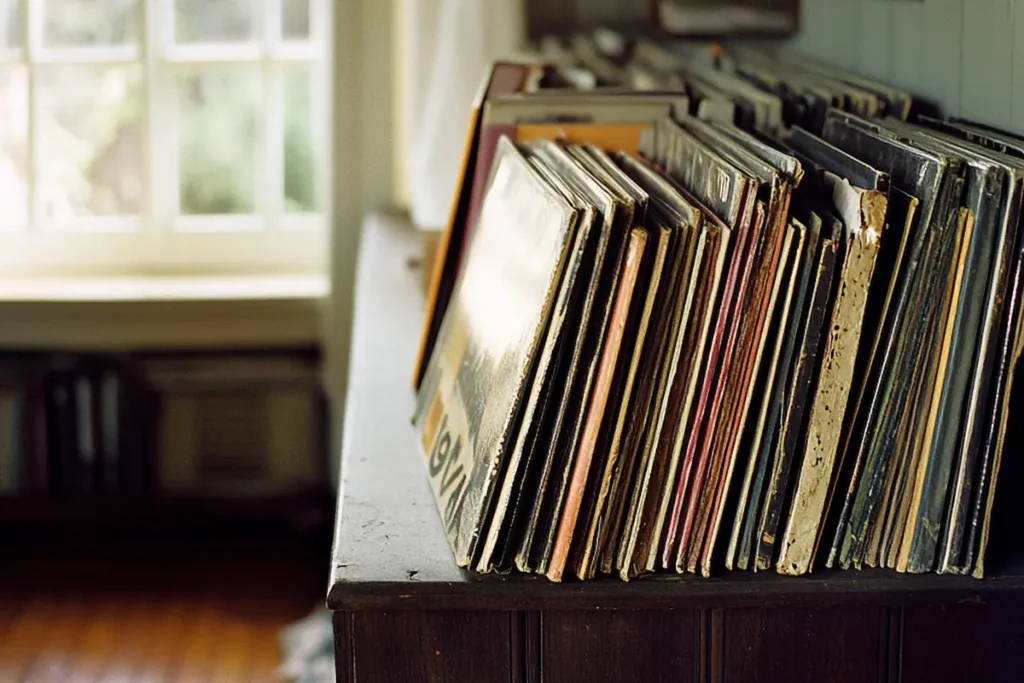
Sellers sometimes downplay the size of what they have – “a few boxes,” “maybe a couple hundred records.” But vinyl collections have a way of being larger and more varied than they seem on first look, especially when they’ve been stored in multiple locations around a home.
Sheer volume tends to produce variety, and variety tends to produce depth. A large collection assembled over decades by a serious listener almost always contains more of interest than a quick glance suggests.
What To Do If Any of This Sounds Familiar
You don’t need to inventory the collection, research individual titles, or become an overnight collector to find out whether what you have is worth selling. That’s exactly what a buyer like DJ Records™ is there for.
We work with complete collections across genres, formats, and conditions, and we review what’s actually in front of us rather than going off a description. For qualifying collections, an in-home visit means the records don’t have to go anywhere before we look at them properly.
If you’ve been sitting on a collection and assuming it isn’t worth much, it costs nothing to find out. The answer might surprise you.
WE BUY OLD RECORDS!
We’ve been buying LPs, 45s, 78s & 12″ singles for well OVER 20 YEARS.
No collection is too large!

I have some 60s country gospel 45s pressed in rome Georgia . Pristine, unplayed, deadstock copies of record # 1556 on MCM label by Elbert and Larry Lindsey and the cherokee mtn boys. I actually have more than this album, but that’s later I guess. I’d like to sell if possible.